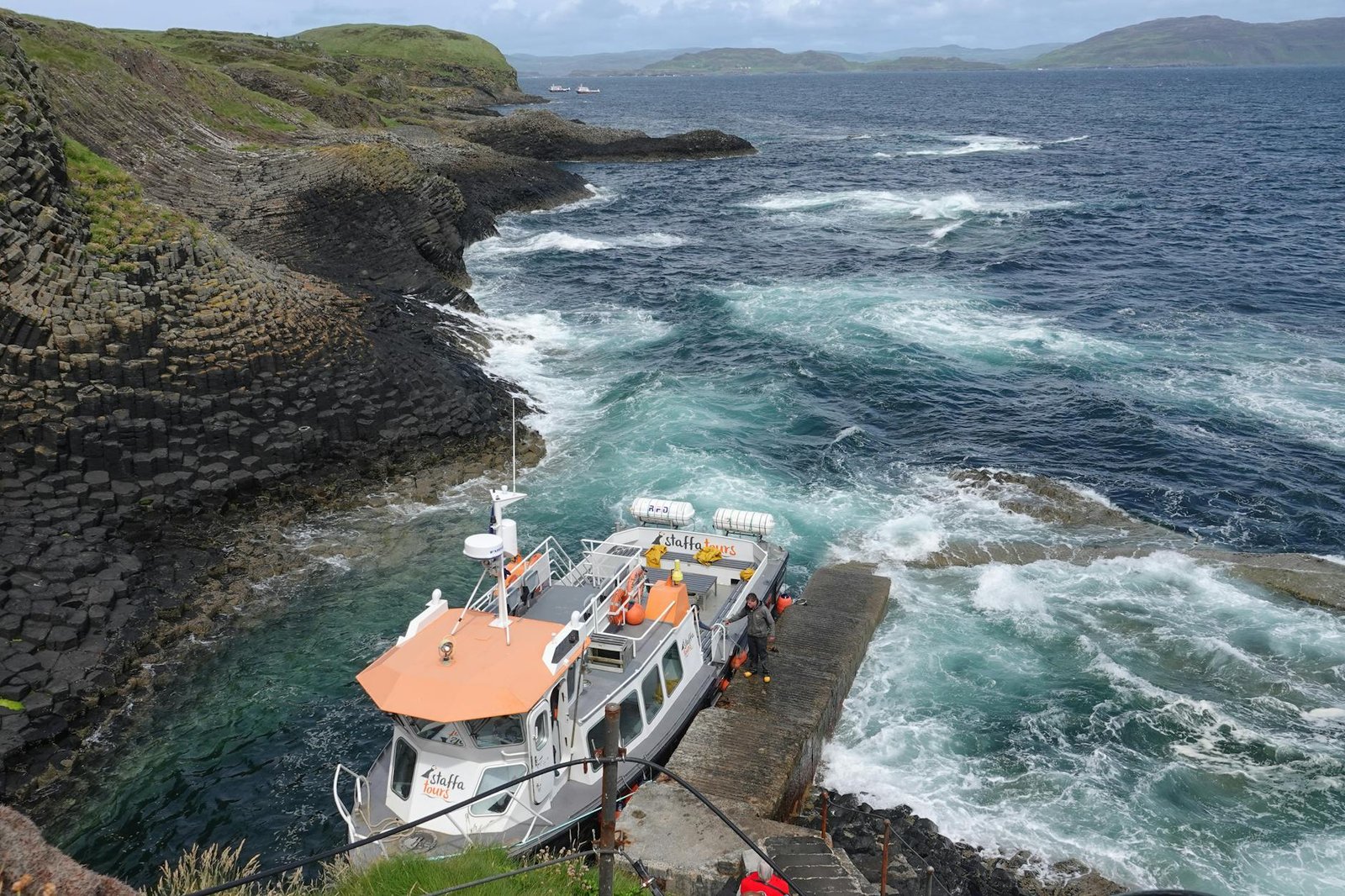
Quick Facts: Port — Isle of Staffa | Country — Scotland, United Kingdom | Terminal — No formal cruise terminal; passengers land via small tender or Zodiac at Staffa’s natural rock platform | Dock or tender — Tender only (weather-dependent) | Distance to “centre” — The entire island is your destination; uninhabited | Time zone — GMT (UTC+0), BST (UTC+1) in summer
Staffa is one of the most extraordinary places a cruise ship will ever drop you off — a tiny, uninhabited volcanic island in the Inner Hebrides, best known for Fingal’s Cave and its jaw-dropping hexagonal basalt columns. Most cruise calls here last just 2–4 hours, and because landing is entirely dependent on sea conditions, the single most important thing to know before you even pack your bag is this: your ship may not be able to land at all, so treat every hour ashore as a gift and move the moment your feet hit the rock.
—
Port & Terminal Information
- Terminal name: There is no cruise terminal on Staffa. The island is uninhabited and protected as a National Nature Reserve managed by the National Trust for Scotland. Larger cruise ships anchor offshore and deploy tenders or Zodiac inflatable craft to bring passengers to the natural rock landing platform on the island’s south side.
- Dock vs. tender: Tender-only, always. Landing is on a low concrete/rock platform built into the basalt formations. The tender ride from ship to shore typically takes 10–20 minutes depending on where your ship anchors.
- Weather dependency: This cannot be overstated. Swells above roughly 1–1.5 metres can make the landing platform unsafe, and the captain will cancel the landing without notice. Ships sometimes anchor, wait, reassess, and occasionally sail away without any passengers going ashore. Build zero hard plans around Staffa — treat it as a bonus.
- Terminal facilities: There are none. No ATM, no luggage storage, no Wi-Fi, no tourist information desk, no café, no toilets with running water. There is a basic composting toilet near the landing platform, maintained by the National Trust. Bring everything you need from the ship.
- Google Maps reference: The island’s location and approach can be orientated using this map search.
—
Getting to the Island

Because Staffa is uninhabited and accessed only by tender from your ship or by privately booked boat tours from Mull, Iona, or Oban, the usual “getting to the city centre” calculus doesn’t apply here. Here’s what you actually need to know about movement:
- On Foot — Once ashore, everything is on foot. The island is roughly 800 metres long and 180 metres wide. The path from the landing platform to Fingal’s Cave takes about 10 minutes at a relaxed pace. The clifftop walk to the island’s summit and back is another 20–30 minutes. There are no roads, no vehicles, and no bikes. Wear proper, non-slip footwear — the basalt columns are wet, uneven, and genuinely treacherous in leather-soled shoes.
- Bus/Metro — Not applicable. The island has no infrastructure of any kind.
- Taxi — Not applicable on Staffa itself. If you’re approaching from Mull, taxis from Craignure or Tobermory to Fionnphort (the ferry point for Staffa/Iona trips) cost approximately £40–£60 each way and take 30–45 minutes.
- Hop-On Hop-Off — Not available.
- Rental Car/Scooter — Not applicable on Staffa. On Mull, car hire is available from Tobermory or Craignure through local operators if you’re combining a Mull stop with a Staffa tender call.
- Ship Shore Excursion — For Staffa specifically, your ship’s organised tender tender schedule is your only realistic option. Unless you have pre-arranged a private boat from a nearby port, there’s simply no alternative way to the island during a cruise call. It is absolutely worth booking your ship’s shore excursion if it includes a guided walk, since the National Trust for Scotland rangers who sometimes accompany groups provide extraordinary geological and ecological context that transforms the visit.
—
Top Things to Do on the Isle of Staffa
The island takes maybe 2 hours to explore thoroughly on foot — but those 2 hours contain some of the most visually arresting geology and wildlife in the entire British Isles. Here’s everything worth doing, roughly in priority order.
—
Must-See
1. Fingal’s Cave (free with landing) — This is the whole reason you’re here. A sea cave carved entirely into interlocking hexagonal basalt columns, stretching 20 metres high and 75 metres deep into the cliffside, with the Atlantic surging through its floor. The acoustics inside are otherworldly — Mendelssohn visited in 1829 and went home to write his Hebrides Overture — and the visual impact of standing at the entrance is genuinely one of the great travel moments in the UK. You access it via a narrow metal walkway bolted to the cave wall above the water; access is sometimes closed in very wet or windy conditions. Allow 20–30 minutes minimum, and take your time. Find guided Staffa boat tours on GetYourGuide if you’re approaching independently from a nearby port.
2. The Basalt Column Formations (free) — Even before you reach the cave, the columnar basalt formations along the island’s base stop you dead. These hexagonal columns formed roughly 60 million years ago as lava cooled uniformly — the same geological event that created the Giant’s Causeway in Northern Ireland. Crouch down and look along the columns, photograph them against the sky, and take a moment to genuinely absorb the fact that this was made by nature without any human assistance. It defies belief every single time. Allow 15–20 minutes just for this stretch.
3. The Clifftop Walk (free) — From the landing platform, a steep but short grassy path leads to the island’s flat summit plateau. From up here, on a clear day, you can see Mull, Iona, the Treshnish Isles, and sometimes as far as the Outer Hebrides. The 360-degree view contextualises how remote and exposed this little lump of volcanic rock actually is. It’s the perspective shot of a lifetime if you have a camera with any kind of wide angle. Allow 20–30 minutes for the round trip from the platform.
—
Beaches & Nature
4. Puffin Watching (free) — Between approximately late April and mid-August, Atlantic puffins nest in the turf on Staffa’s clifftops and grassy upper slopes. In peak season (May–July), you can stand within a few metres of them as they come and go from their burrows. They are absurdly photogenic and almost entirely unbothered by respectful visitors. This is genuinely one of the best accessible puffin-watching spots in Scotland — no long hike, no hide, just birds going about their business a few feet from you. If puffins are a priority for your trip, the 4-Day Mull, Iona and Staffa Puffin Experience from Edinburgh is specifically designed around peak nesting season 🎟 Book: 4 Day Mull, Iona and Staffa Puffin Experience from Edinburgh. Allow as long as you have — they’re addictive.
5. Grey Seal Spotting (free) — Grey seals haul out on the rocks around Staffa’s shoreline year-round, and you’ll almost certainly see them from the tender on approach. Keep your eyes on the water during the tender ride and along the lower rock platforms — they’re curious, fat, and often completely unbothered by boats. No time needed beyond general watchfulness.
6. Birdwatching Beyond Puffins (free) — Staffa’s airspace also hosts razorbills, guillemots, kittiwakes, fulmars, and shags, particularly on the sea cliffs. Bring binoculars if wildlife is your priority. The waters around the island are also a reasonable location for seeing dolphins, porpoises, and even minke whales, particularly in summer. Allow 15–30 minutes of deliberate scanning if you’re a birder.
7. The Natural Arch at Boat Cave (free) — On the island’s north side, accessible via the clifftop walk, there’s a second sea cave called Boat Cave (sometimes called MacKinnon’s Cave in historical references, though this name more accurately belongs to a cave on Mull). The rock arch above it and the columnar formations here are less visited than Fingal’s Cave simply because most people don’t walk the full circuit — which means you can often have it largely to yourself. It’s a short detour off the main path. Allow 15 minutes.
—
Day Trips
Because Staffa is itself the day trip, the “day trips from Staffa” section covers what to combine when you have a full free day and are approaching from a nearby hub rather than from your cruise ship.
8. Iona Combined Visit (ferry from Fionnphort: approximately £15–20 pp return) — Most independent day-trip boats from Fionnphort or Mull combine Staffa with a stop on Iona, the tiny island where Christianity came to Scotland in the 6th century via St Columba. Iona Abbey is a working, living religious community and one of the most sacred sites in Britain. If your ship stops at Mull or if you have a pre- or post-cruise day in the area, combining Iona and Staffa in one day is extraordinarily good value and deeply moving. A 5-Day Iona, Mull and Staffa Small-Group Tour from Edinburgh gives you proper time with all three 🎟 Book: 5-Day Iona, Mull and the Isle of Skye Small-Group Tour from Edinburgh. Allow a full day from Fionnphort.
9. Isle of Mull Exploration (various) — If your ship calls at Craignure or Tobermory on Mull, you’re in the gateway port for independent Staffa boat trips. Mull itself is worth exploring: Duart Castle (open May–Oct, adults £9), the colourful harbourfront of Tobermory, and some of the best otter-watching habitat in Europe along the island’s western coastline. A Private 4-Day Tour of Isle of Mull and Iona gives you Mull in real depth 🎟 Book: Private 4 Day Tour in Isle of Mull and Iona . Allow 4–8 hours for Mull depending on what you choose.
10. Treshnish Isles Boat Trip (from approximately £60–90 pp, booked from Mull) — The Treshnish Isles are a chain of uninhabited volcanic islands a few miles northwest of Staffa, known for grey seal colonies and even larger puffin populations than Staffa itself. Many day-trip boats from Ulva Ferry or Dervaig on Mull include both Staffa and the Treshnish in a single excursion. Check Viator’s Staffa search for current tour options with availability and pricing. Allow 6–8 hours from Mull.
—
Family Picks
11. Rock Pooling Around the Landing Platform (free) — The basalt shelves around the landing area are riddled with rock pools full of sea anemones, crabs, starfish, and small fish. Kids who are confident on uneven surfaces will love exploring while adults photograph the cave. Stay close to the platform and keep a firm eye on little ones — the rock is slippery and the sea is cold and powerful. Allow 20–30 minutes.
12. “Standing Inside a Volcano” Storytelling (free) — It sounds dramatic, but it’s essentially true — you’re standing on the remnants of a massive volcanic event. The National Trust Scotland rangers who sometimes accompany cruise groups are brilliant at explaining this to children in vivid, memorable terms. If a ranger is present during your visit, get your children close. No time required beyond the general visit.
—
Off the Beaten Track
13. The Island’s Interior Meadow (free) — Most visitors go straight to Fingal’s Cave and back without ever walking the interior. The flat summit of the island is a wildflower meadow in summer — thrift, sea campion, and tormentil — and in June it’s genuinely beautiful and completely deserted while everyone else is at the cave. Walk up the central path and turn away from the clifftop view for a few minutes. You’ll almost certainly be alone. Allow 10–15 minutes.
14. Arrival by Tender — Watch the Approach (free) — This sounds odd as a recommendation, but the approach to Staffa by tender is one of the great small-boat experiences in Scottish waters. The moment when the columns rise out of the sea directly in front of you, and the dark mouth of Fingal’s Cave becomes visible, is something people remember for decades. Put your phone away for 60 seconds and just look. It costs nothing and takes exactly as long as the tender ride.
—
What to Eat & Drink

There is nothing to eat or drink on Staffa — no café, no kiosk, no vending machine of any kind. The island is completely undeveloped by design, and the National Trust for Scotland intends to keep it that way.
Bring snacks and water from your ship before you board the tender. If you’re approaching via an independent boat from Mull or Fionnphort, eat before you leave — the boat trips typically take 1–2 hours each way, and most don’t have galley facilities. Here’s what to eat and drink in the areas you’re most likely to be based around:
- Fresh Scottish seafood in Tobermory, Mull — The harbour area has several restaurants and cafés serving langoustines, mussels, and smoked salmon caught locally; price range approximately £12–£22 for a main.
- Tobermory Fish & Chips — A proper, unpretentious chippy near the Tobermory harbourfront; haddock and chips approximately £8–£12; a mandatory Mull ritual.
- Fionnphort Village Shop/Café — A tiny community shop near the Iona ferry terminal; sandwiches, hot drinks, and basics for approximately £3–£7; practical rather than gastronomic.
- The Keel Row, Tobermory — A pub-restaurant on the harbourfront with good bar food, local ale, and a warm atmosphere after a wet day on the water; mains £11–£18.
- Iona Abbey Coffee Shop — If your trip combines Staffa with Iona, the abbey has a small café serving homemade soup, scones, and coffee; approximately £3–£7; serene setting.
- Isle of Mull Cheese — Not a restaurant, but a local product worth knowing about. The Sgriob-ruadh Farm near Tobermory produces award-winning Scottish cheddar; pick some up at the farm shop or in Tobermory for approximately £6–£12 per piece.
- Single malt whisky — Tobermory Distillery is one of Scotland’s oldest working distilleries, right on the Tobermory harbourfront. Tours cost approximately £15–£20 per person and include a tasting. A dram at the distillery bar is approximately £5–£9.
—
Shopping
There is no shopping whatsoever on Staffa. The island has no permanent human inhabitants, no shops, no market stalls, and no facilities beyond the basic landing infrastructure.
If shopping matters to your day, focus your energy on Tobermory on Mull, which has a charming main street of independent shops along its famous colourful harbourfront. Look for locally made knitwear and Harris Tweed items (expect £40–£150+ for quality pieces), Isle of Mull chocolate from the Tobermory chocolate shop (approximately £3–£8 per bar), locally produced gin from Tobermory Distillery’s sister brand Tobermory Gin (approximately £35–£45 for a bottle), hand-carved driftwood pieces, and Celtic jewellery from local craftspeople. Skip the generic “Scotland” tartan souvenirs that are mass-produced in China and sold in tourist shops — they have nothing to do with the Hebrides specifically. The things worth buying here are the things made here.
—
How to Plan Your Day
- 2–3 hours ashore (typical cruise call): Board the tender as early as possible — early tenders are less crowded and give you the most time. Walk directly to Fingal’s Cave via the lower cliff path (10 minutes from landing). Spend 20–30 minutes at the cave entrance, go inside if conditions allow, and photograph the columns along the way. Return via the slightly higher path and, if puffins are in season,
🎟️ Things to Book in Advance
These highly-rated experiences fill up fast — book before you arrive to avoid missing out.


This page contains affiliate links. If you book through them, we may earn a small commission at no extra cost to you.
📍 Getting to Isle of Staffa, Scotland
Use the interactive map below to explore the port area and plan your route from the terminal.
Leave a Reply