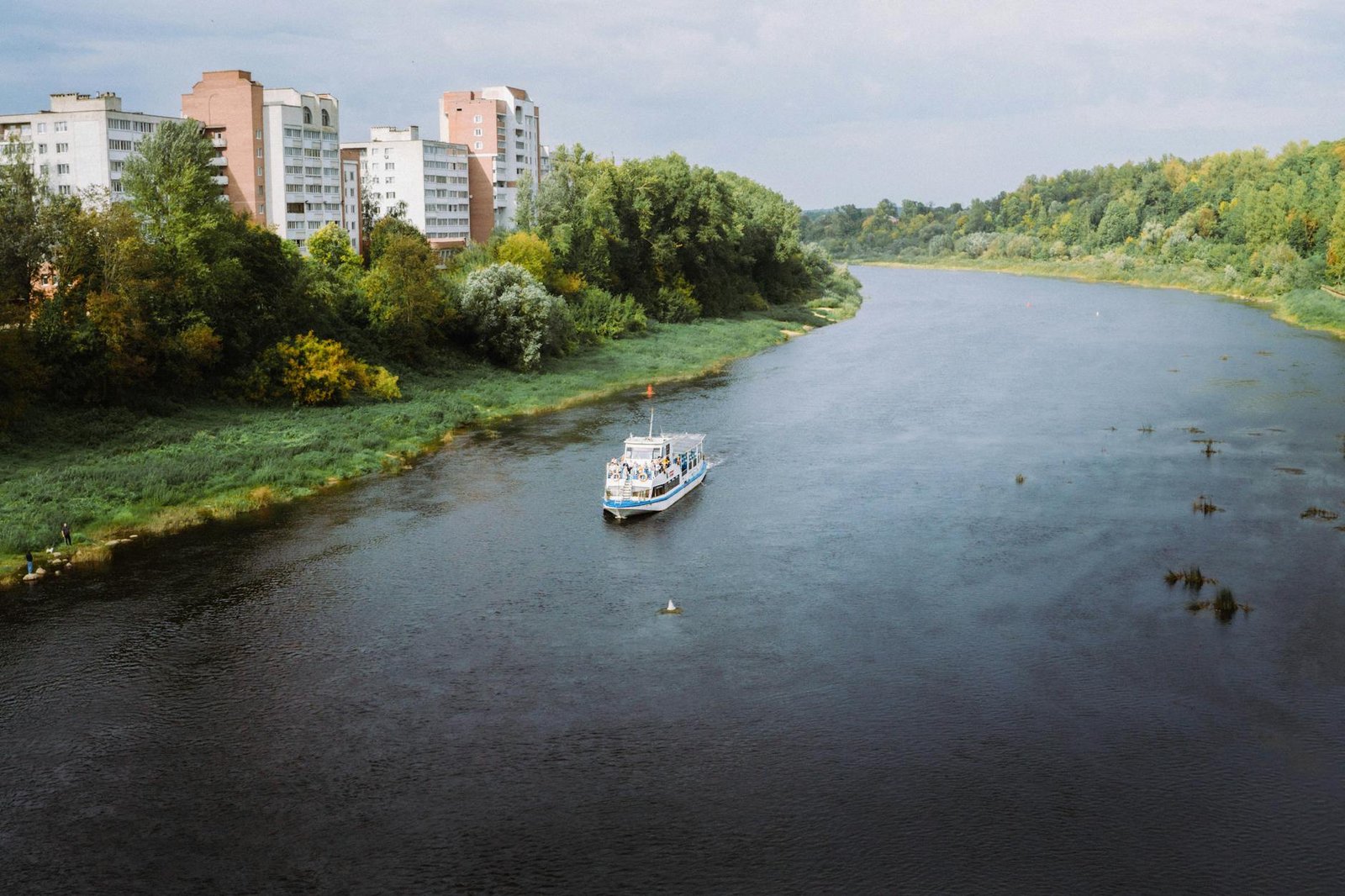
Quick Facts: Port: Kuzino | Country: Russia | Terminal: Kuzino River Pier (informal village landing stage) | Docking: Direct dock (no tender required at most stops) | Distance to nearest town center (Kotlas region): approximately 15–25 km depending on itinerary routing | Time zone: UTC+3 (Moscow Time)
Kuzino is a small riverside settlement on the Northern Dvina, typically called as a scenic stop on extended Russian river cruises — usually those running between Vologda, Veliky Ustyug, and Arkhangelsk. The single most important planning tip you need before stepping ashore: this is a deeply rural, off-grid stop with virtually no tourist infrastructure on the pier itself, so everything you do here requires advance planning or reliance on your ship’s excursion team.
—
Port & Terminal Information
There is no formal cruise terminal building at Kuzino in the way you’d find at a major port city. Vessels tie up at a basic riverside landing stage — a floating pontoon or reinforced bank depending on water levels and vessel size — and passengers simply walk down a gangway directly onto the riverbank or a gravel path.
Facilities at the landing are minimal by design:
- ATMs: None at the pier. Bring cash (Russian rubles) before you arrive — the nearest ATM is in a larger village or town on the route, likely 15–20 km away.
- Luggage storage: Not available ashore. Leave bags on the ship.
- Wi-Fi: No public Wi-Fi at the pier; your best option is your ship’s onboard connection.
- Tourist info desk: No formal office. Your cruise director or shore excursion manager is your best information source — brief them the night before.
- Shuttle: No public shuttle service. Transport is entirely arranged through the ship or pre-booked private transfers.
Use [Google Maps](https://www.google.com/maps/search/Kuzino+cruise+terminal) to orient yourself relative to the landing area before you arrive, and screenshot maps offline because cellular data can be unreliable in this stretch of the Dvina.
—
Getting to the City

Because Kuzino is a small rural settlement rather than a port city, “getting to the city center” means getting to the nearest point of meaningful infrastructure — a nearby village, a local monastery, or a market town depending on your ship’s itinerary. Here’s how transport works in practice:
- On Foot — The immediate riverbank and surrounding meadows are walkable and genuinely beautiful, especially in summer when wildflowers line the Dvina shores. Don’t expect to walk to anything with an address: the nearest cluster of houses may be 1–3 km on unpaved paths, and landmarks are sparse.
- Bus/Metro — There is no metro and no scheduled bus service from the Kuzino landing. Rural bus routes in this part of Arkhangelsk Oblast are infrequent (sometimes 1–2 runs per day) and not timed to cruise arrivals. Do not rely on public buses for shore day planning.
- Taxi — Local taxis can be arranged through your ship or by Russian-language phone call. Expect to pay approximately 800–1,500 RUB (roughly $9–17 USD at mid-2024 exchange rates) for a one-way trip to the nearest significant village or attraction. Agree on the fare before you get in, confirm the driver knows your ship’s departure time, and get a phone number in case you need a return pick-up. Scam risk is low in these rural areas — locals are generally hospitable — but language barriers are real.
- Hop-On Hop-Off — No HOHO service exists anywhere near Kuzino. Skip this option entirely.
- Rental Car/Scooter — Rental agencies do not operate in this area. Not a practical option from the pier.
- Ship Shore Excursion — For a stop like Kuzino, the ship excursion is genuinely worth it, possibly more so than at any other port on the Dvina itinerary. The cruise line will have arranged a local guide, transport, and access to sites that would be nearly impossible to reach independently without a Russian-speaking driver and advance permissions. Check [Viator’s Kuzino search](https://www.viator.com/search/Kuzino) for any third-party options, and browse [GetYourGuide](https://www.getyourguide.com/s/?q=Kuzino¤cy=USD&partner_id=MHU0UHU) for guided experiences in the broader Northern Dvina region that might be bookable in advance.
—
Top Things to Do in Kuzino, Dvina River, Russia
The appeal of a Kuzino stop isn’t a checklist of famous sights — it’s the texture of deep rural Russia that almost no Western traveler ever sees. Here’s how to make the most of the time you have ashore, organized by type of experience.
—
Must-See
1. The Northern Dvina Riverbank Walk (Free) — Step off the gangway and simply walk the bank for 20–30 minutes in each direction. The Northern Dvina at this latitude is an extraordinary river — wide, quiet, flanked by birch and pine, with the occasional wooden fishing boat pulled up on the shore. This is not a “sight” but it’s often the most memorable thing cruisers take home from this stop. No link needed — just walk. Allow 45–60 minutes.
2. Local Wooden Village Architecture (Free) — The villages surrounding the Kuzino area are textbook examples of traditional Northern Russian wooden construction: high-pitched roofs, carved decorative window surrounds (called nalichniki), and two-story log homes that have stood for a century or more. Walk slowly and look up — the craftsmanship is extraordinary. A [guided tour on GetYourGuide](https://www.getyourguide.com/s/?q=Kuzino¤cy=USD&partner_id=MHU0UHU) covering Northern Russian wooden architecture may include stops at villages in this river corridor. Allow 1–2 hours.
3. Village Church or Chapel Visit (Free / small donation welcome) — Almost every settlement along the Northern Dvina has a surviving Orthodox church, even if partially ruined or recently restored. These small whitewashed or wooden churches, often sitting directly above the riverbank, are deeply moving in their quietness. Dress modestly (see Practical Information below). Allow 20–30 minutes.
4. Meeting Local Residents (Free) — This sounds vague, but it’s one of the genuinely rare and valuable things about a stop like Kuzino. Villages here are inhabited by elderly Russians who have lived entire lives along this river. If your ship arranges a home visit or a local woman brings out bread and salt (the traditional Russian welcome), say yes immediately — these encounters are why people take Dvina cruises. Allow as much time as is offered.
—
Beaches & Nature
5. Dvina Sandbanks & Swimming (Seasonal) (Free) — In summer (June–August), the Dvina’s sandbanks create calm, shallow bathing spots that locals use happily. Water temperatures can reach 18–22°C in peak summer. If your ship stops mid-afternoon on a warm day, ask your cruise director whether a swim is safe at that particular bend of the river. Allow 1–2 hours.
6. Riverside Meadow Wildflower Walks (Free) — The floodplain meadows along the Northern Dvina between Kotlas and Arkhangelsk are spectacular in June and early July — carpeted with oxeye daisies, fireweed, lupines, and buttercups. Bring a camera with a macro setting. Allow 30–60 minutes.
7. Bird Watching on the Dvina Floodplains (Free) — The Northern Dvina corridor is a significant flyway for European waterfowl. White-tailed eagles, ospreys, grey herons, and black storks have all been recorded in this stretch. Bring binoculars from the ship. Allow 1–2 hours.
—
Day Trips
8. Veliky Ustyug (Approx. 200–300 RUB museum entry / 3,000–5,000 RUB transport) — If your ship itinerary positions you close enough, Veliky Ustyug is the most historically rich city in this part of Russia — a medieval trading town with remarkable churches, a kremlin-style ensemble, and a famous role as Russia’s “home of Father Frost” (Ded Moroz). Check whether your cruise line offers this as a shore excursion, or search [Viator for Veliky Ustyug tours](https://www.viator.com/search/Kuzino). Allow a full day.
9. Kotlas Town Center (Free to walk / museum entry 150–300 RUB) — Kotlas is the nearest significant rail junction and regional center, with a local history museum, a covered market, and Soviet-era architecture worth seeing. It’s not a headline destination, but it’s a real Russian town unfiltered by tourism, and that has its own value. Allow 3–4 hours with transport.
—
Family Picks
10. Dvina Fishing with a Local Guide (Approx. 2,000–4,000 RUB per person, arranged through ship) — Northern Russian rivers are legendary for pike, perch, and in the right season, salmon. A short guided fishing session — even if you catch nothing — is a fantastic way to spend 2 hours with children alongside the river. Ask your cruise director to arrange this at least a day before arrival. Browse [GetYourGuide](https://www.getyourguide.com/s/?q=Kuzino¤cy=USD&partner_id=MHU0UHU) for similar river experiences in the Dvina corridor. Allow 2 hours.
11. Traditional Craft Demonstration (Often included in ship excursions / approx. 500–1,000 RUB independently) — Some river cruise itineraries on the Dvina arrange for local artisans — birch bark weavers, lace makers, or folk embroiderers — to give demonstrations at village community halls. Children find the hands-on weaving workshops particularly engaging. Allow 1–1.5 hours.
—
Off the Beaten Track
12. Forest Foraging Walk (Free / guide approx. 1,500–2,500 RUB) — The taiga forest that begins just beyond the Dvina floodplain is accessible on foot from most landing points. In late summer (August–September), wild mushrooms (white mushrooms, chanterelles) and berries (cloudberries, bilberries) are abundant. A local guide can teach you to identify what’s edible — this is an experience that exists almost nowhere else on European river cruise itineraries. Allow 2–3 hours.
13. Soviet-Era Collective Farm (Kolkhoz) Remnants (Free) — The landscape around many Dvina villages still bears the physical marks of Soviet agricultural collectivization: vast empty barns, rusting machinery, regimented tree plantings, and faded murals on village buildings. It’s unsettling and historically fascinating in equal measure. No organized tour needed — just walk with open eyes. Allow 30–60 minutes.
14. Night-Time Dvina (White Nights, June) (Free) — If your cruise runs in early June, you’ll experience the White Nights at this northern latitude: the sky never fully darkens, and at 11 PM the river is bathed in a pale gold light that is genuinely otherworldly. If your ship allows evening deck access while moored at Kuzino, don’t miss it. Allow as long as you like.
—
What to Eat & Drink

Food along the Northern Dvina is rooted in the traditions of northern Russian peasant cooking — hearty, seasonal, heavy on preserved fish, root vegetables, and rye bread, with almost no international influence this far from the major cities. Don’t come expecting restaurants with menus in English; come expecting home-cooked food that tells you exactly where you are in the world.
- Ukha (fish soup) — The Northern Dvina’s version uses fresh-caught river fish, often pike or perch, with potato, onion, and dill. If a local offers you ukha, it’s almost certainly cooked that morning. Price range in local canteens: 150–250 RUB ($1.70–$2.80).
- Rye bread (cherny khleb) — Dark, dense, slightly sour, and absolutely delicious. Local bakeries in nearby villages sometimes sell loaves informally. 50–80 RUB per loaf.
- Pirozhki — Small baked or fried pastries filled with cabbage, mushroom, or minced fish. Sold at village markets and sometimes brought to the pier by local vendors. 50–100 RUB each.
- Kvass — A fermented rye bread drink, lightly alcoholic (0.5–1%), sold from barrels in larger villages in summer. Cold, refreshing, and deeply Russian. 50–80 RUB per cup.
- Salted and smoked river fish — Pike, carp, and perch are all traditionally salted and cold-smoked in the north. Look for this at any informal market. A wrapped portion costs 200–500 RUB and makes an excellent (if pungent) souvenir to eat on the ship.
- Varenye (homemade jam) — Jars of cloudberry, lingonberry, or bilberry jam are commonly sold by village women near the pier. 200–400 RUB per jar and far better than anything from a supermarket.
- Ship dining — Be realistic: your best hot meal on a Kuzino stop day is probably dinner back on board. Most ships on Dvina itineraries serve excellent Russian cuisine in the dining room — use the shore day for snacking and discovery, not restaurant dining.
—
Shopping
Shopping at a stop like Kuzino is informal, spontaneous, and infinitely more interesting than anything you’d find in a souvenir shop. Local women — often babushkas in headscarves — sometimes appear at the landing with handmade goods: birch bark baskets, linen embroideries, hand-knitted wool socks, small wooden toys, and jars of forest preserves. Prices are low and negotiation is gentle — a warm smile and basic Russian phrases (spasibo = thank you, skolko stoit? = how much?) go a long way. Bring small-denomination ruble notes because vendors rarely have change for large bills.
What to skip: any mass-produced “Russian” souvenirs — matryoshkas, printed scarves, lacquer boxes — that look identical to things sold in Moscow airport. These will occasionally appear even in remote stops and are not locally made. The real treasures here are the handmade, anonymous things: a jar of cloudberry jam, a pair of knitted mittens, a small birch bark box. These cost almost nothing and mean everything as a memory of the Dvina.
—
How to Plan Your Day
- 4 hours ashore: Walk the riverbank for 45 minutes in each direction from the gangway. Visit the nearest village church. Buy something from whoever is selling at the pier. Return to the ship in time for lunch, having genuinely seen something most travelers never will.
- 6–7 hours ashore: Add a guided village walk with a local interpreter (arrange through the ship the night before). Stop at a community center or village hall if one is open. Try to join a home visit if offered. Walk the floodplain meadows before returning, and pick up smoked fish and jam at the pier.
- Full day (8+ hours): Take the ship’s organized day excursion to Veliky Ustyug or Kotlas in the morning, combining a historic town visit with museum stops and a market lunch. Return to Kuzino mid-afternoon for independent riverbank time — foraging walk, birdwatching, or simply sitting on the bank watching the Dvina move. This is one of the few shore days in world cruising where “doing nothing” is genuinely the right afternoon choice.
—
Practical Information
- Currency: Russian Ruble (RUB, ₽). Card acceptance is essentially zero at rural piers and village markets. Bring cash — ideally in a range of denominations (50, 100, 200 RUB notes are most useful). Exchange money before your Dvina cruise begins, not at the pier.
- Language: Russian. English is spoken by almost nobody outside of your ship’s crew and possibly a hired guide. Download the Google Translate app with the Russian language pack available offline before you sail.
- Tipping: Not a formal expectation in rural Russia, but genuinely appreciated. Tip guides 200–500 RUB per person; leave a small amount (100–200 RUB) if a local family hosts you in their home.
- Time zone: UTC+3 (Moscow Time, no daylight saving). Russian river cruise ships typically operate on Moscow Time throughout, so your ship clock and local time should match — but confirm with your cruise director.
- Safety: Rural Northern Russia is very safe for
📍 Getting to Kuzino, Dvina River, Russia
Use the interactive map below to explore the port area and plan your route from the terminal.
Leave a Reply