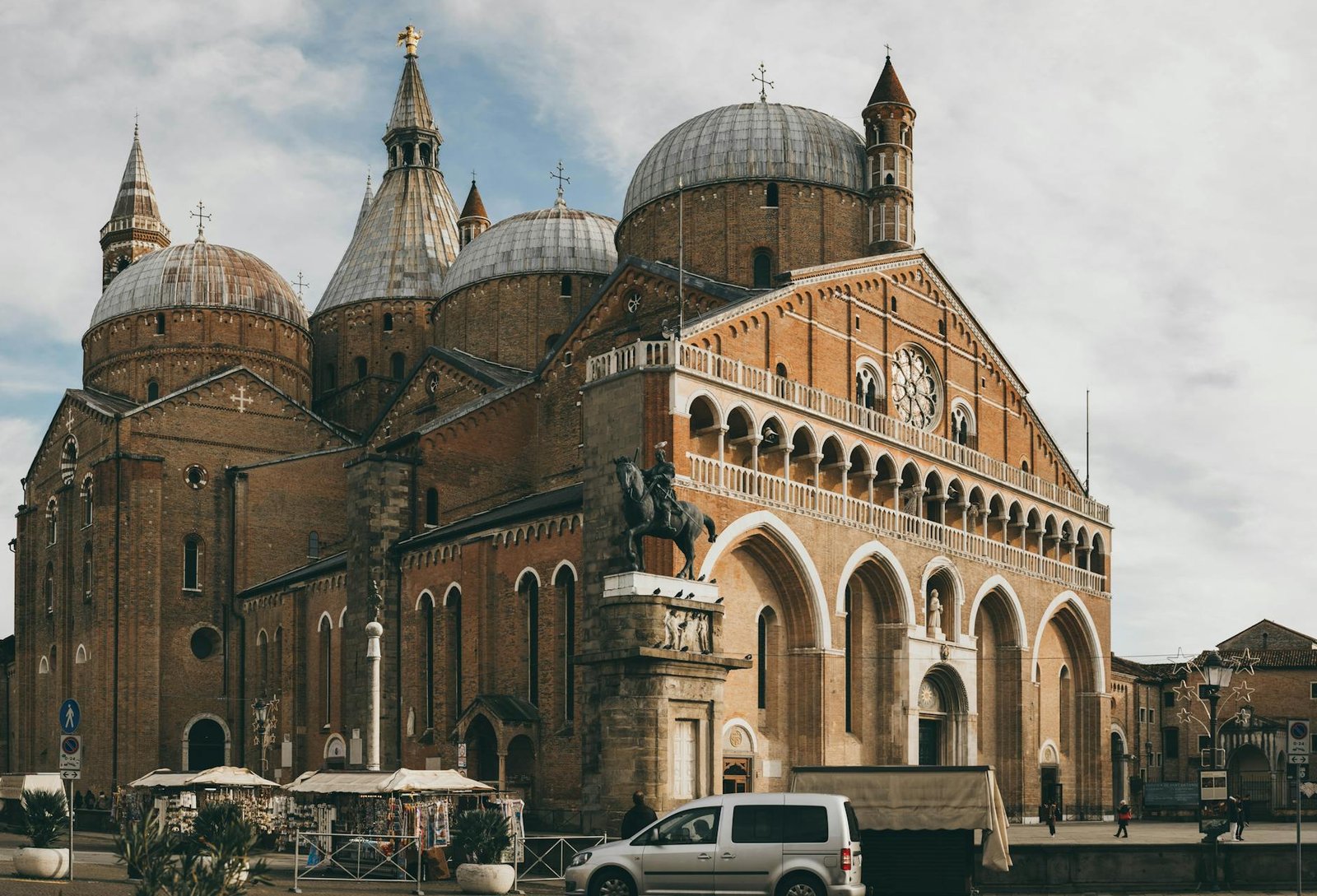
Padua sits in the shadow of Venice, which is frankly absurd. This compact Veneto city packs a Giotto masterpiece, the world’s oldest botanical garden, and one of Europe’s greatest medieval squares into a single, walkable day ashore.
—
Arriving by Ship
Padua itself has no cruise port — ships dock at the nearby Port of Venice (Venezia Marghera or the Stazione Marittima). From there, Padua is roughly 35–40 kilometres west, easily reached by direct train from Venice Santa Lucia station in just 25–35 minutes, with trains running frequently throughout the day.
The train ride is cheap, smooth, and stress-free — tickets cost around €4–6 each way and are bookable on Trenitalia’s website or at station machines. Once in Padua, the historic centre is compact enough to explore almost entirely on foot.
—
Things to Do

Padua rewards curiosity at every turn — there’s a Giotto fresco cycle that changed the history of Western art, a piazza big enough to lose yourself in, and a university that’s been running since 1222. Here’s where to spend your hours.
History & Art
- Scrovegni Chapel — Giotto’s 1305 fresco cycle covering the life of Christ and the Virgin is one of the greatest artworks in existence; entry must be pre-booked and costs around €15, with timed 15-minute slots. A guided small-group tour makes the symbolism genuinely click. 🎟 Book: Padua small group tour with Scrovegni Chapel entrance
- Palazzo della Ragione — The vast 13th-century law court contains a single medieval hall nearly 80 metres long, decorated with astrological frescoes; entry is around €6 and it’s open Tuesday–Sunday.
- Padua University’s Anatomy Theatre — Built in 1595, this is the oldest surviving anatomical theatre in the world; guided tours run several times daily and cost around €5 per person.
Squares & Streets
- Piazza delle Erbe and Piazza dei Frutti — These twin market squares flanking the Palazzo della Ragione hum with stalls selling produce, cheese, and local goods every morning except Sunday.
- Prato della Valle — One of the largest squares in Europe, ringed by 78 statues on a moated island; it’s free to visit and utterly photogenic at any time of day.
- Basilica di Sant’Antonio — Pilgrims have been coming here since the 13th century; the interior is breathtaking and entry is free, though dress modestly.
For the Curious
- Orto Botanico di Padova — Founded in 1545, this is the world’s oldest university botanical garden and a UNESCO World Heritage Site; entry is €10 and it’s open daily.
- Self-guided audio scavenger hunt — If you prefer exploring at your own pace with a bit of fun built in, a self-guided audio tour is a brilliant and budget-friendly option. 🎟 Book: Padua Scavenger Hunt and Highlights Self Guided Audio Tour
- Winery tour in the Euganean Hills — Padua’s surrounding hills produce excellent Moscato and Fior d’Arancio; a short winery excursion with tasting takes just an hour and is a lovely change of pace. 🎟 Book: Winery Tour and Tasting on Padua Hills
—
What to Eat
Paduan cooking is hearty, honest, and deeply rooted in the Veneto tradition — think slow-braised meats, polenta, and bitter greens. Skip any tourist-facing menu near the basilica and head for the streets around Piazza delle Erbe instead.
- Bigoli con l’anatra — Thick whole-wheat pasta with duck ragù; look for it at Trattoria dei Porteghi on Via Cesare Battisti for around €12–14.
- Baccalà alla vicentina — Creamy salt cod braised in milk and onions, served over white polenta; widely available across trattorie for €10–15.
- Spritz Aperol — Born in the Veneto, this is the local aperitivo of choice; a glass at a bar on Piazza delle Erbe costs around €3–4.
- Cicchetti — Small bar snacks similar to Venetian tapas; grab a plate at any bacaro (wine bar) for €1–3 per piece alongside a glass of local white.
- Frittelle — Sweet fried dough balls, particularly popular in winter and carnival season; found at bakeries throughout the centre for €1–2 each.
- Gelato at Grom — The Padua branch on Via Roma serves excellent quality gelato; expect to pay €3–4 for a two-scoop cup.
—
Shopping

The morning markets on Piazza delle Erbe and Piazza dei Frutti are the best places to shop — local honey, aged Asiago cheese, dried porcini mushrooms, and Veneto wines all travel well and make meaningful souvenirs. The covered market beneath Palazzo della Ragione is worth a browse for cured meats and regional specialities.
Avoid the generic tourist shops clustering near Sant’Antonio selling mass-produced ceramics and plastic gondolas — they’re poor value and have nothing to do with Padua specifically. Instead, look for a bottle of Fior d’Arancio Euganeo DOC wine or a small jar of local truffle paste.
—
Practical Tips
- Currency: Italy uses the Euro (€); carry some cash for markets and smaller bars.
- Tipping: Not expected in Italy, though rounding up the bill is appreciated.
- Transport: The train from Venice to Padua is by far the easiest and cheapest option — validate your ticket before boarding.
- Best time ashore: Leave the ship early; aim to be in Padua by 9am to beat tour groups at the Scrovegni Chapel.
- Time needed: A full six to seven hours gives you enough time for the key sights, lunch, and a wander.
- Dress code: Cover shoulders and knees for the Basilica di Sant’Antonio — scarves are available at the entrance if needed.
- Pre-booking: The Scrovegni Chapel sells out days in advance — book online before your cruise departure.
- Safety: Padua is very safe; keep an eye on bags in crowded market areas as a general precaution.
—
Leave Padua with a full stomach, a bottle of Veneto wine in your bag, and the quiet satisfaction of having discovered what most cruise passengers completely miss.
🎟️ Things to Book in Advance
These highly-rated experiences fill up fast — book before you arrive to avoid missing out.


This page contains affiliate links. If you book through them, we may earn a small commission at no extra cost to you.
📍 Getting to Padua, Italy
Use the interactive map below to explore the port area and plan your route from the terminal.
Leave a Reply