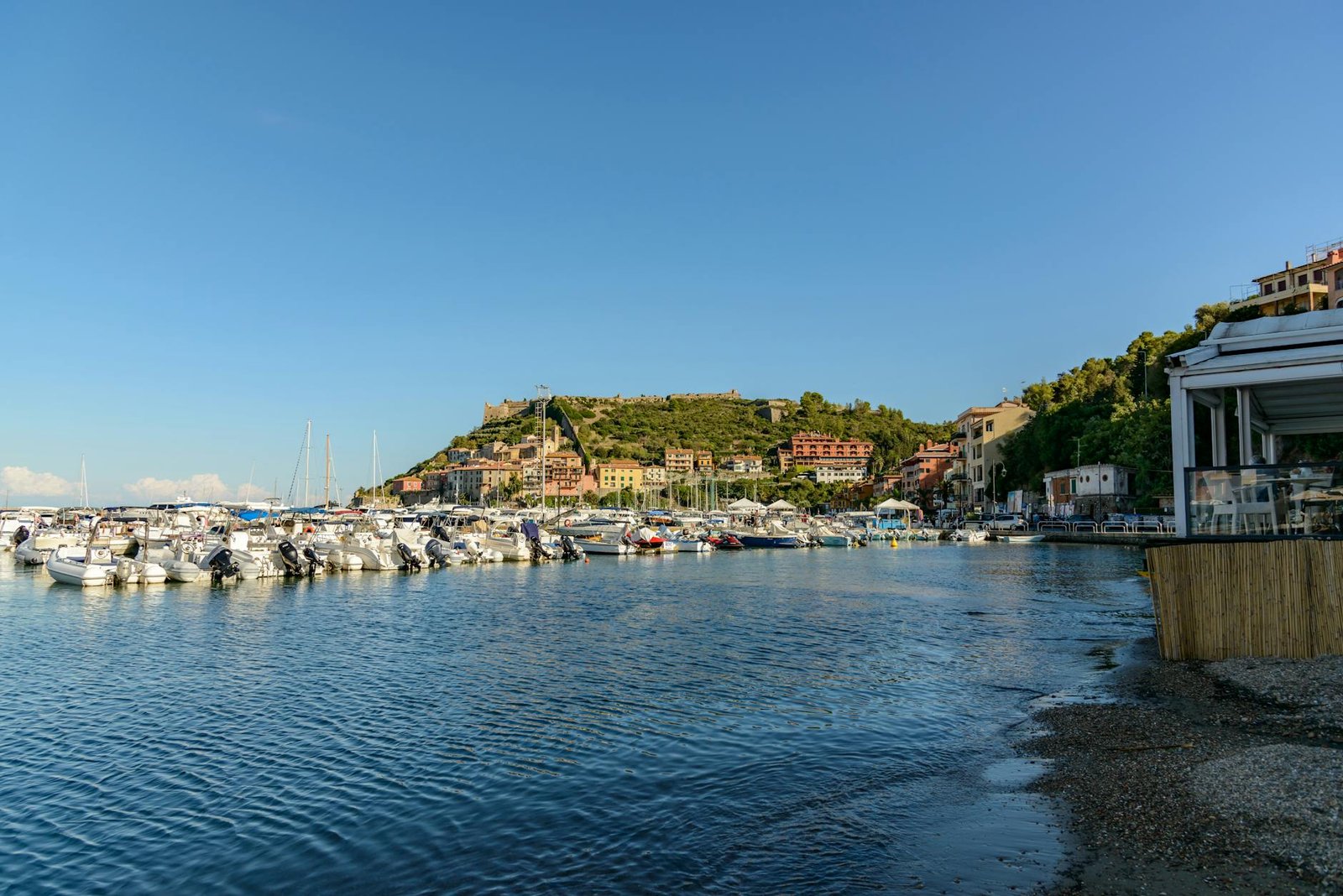
Tucked into the rocky headlands of Monte Argentario on Tuscany’s lesser-known coastline, Porto Ercole is the kind of Italian village that makes you wonder why everyone else is rushing to Florence. Arriving by ship, you’re greeted by a cascade of terracotta rooftops, ancient Spanish fortresses clinging to clifftops, and water so clear it shifts between green and deep sapphire depending on the hour. This is the Maremma coast at its most seductive — unhurried, authentic, and quietly magnificent.
Arriving by Ship
Smaller cruise vessels and luxury yachts tend to anchor offshore in the sheltered natural harbour, with tender boats ferrying passengers to the small quayside. The arrival itself is genuinely cinematic. As you approach, the three 16th-century Spanish fortifications — Fort Stella, Fort Filippo, and the Rocca — emerge from the hillside like something from a painted backdrop, their weathered stone walls glowing amber in the morning light.
The village is compact and entirely walkable from the tender pier. Cobbled lanes wind upward through the medieval borgo, where cats sleep on doorsteps and locals conduct leisurely morning conversations outside the pasticceria. If your ship docks at nearby Porto Santo Stefano instead, the two harbours are connected by a short road around the promontory. For onward travel further afield, a private transfer to Rome or Fiumicino Airport is a smooth and scenic option. 🎟 Book: Private Transfer from Porto Santo Stefano/Porto Ercole to Rome or FCO Equally, if you’re joining a cruise here from the capital, arriving in style via private car sets the right tone from the very first moment. 🎟 Book: Private Transfer from Rome or FCO to Porto Santo Stefano/Porto Ercole
Things to Do

Porto Ercole rewards slow exploration above almost everything else. Start by climbing through the medieval gates into the Spanish Quarter — the old walled town — where narrow alleyways open unexpectedly onto panoramic terraces overlooking the bay. It costs nothing and delivers everything.
History lovers will want to linger at the fortresses. Fort Stella, in particular, offers sweeping views across the Tyrrhenian Sea and the protected lagoon of the Orbetello nature reserve. The painter Caravaggio died near here in 1610, and a modest memorial marks the spot — an oddly moving footnote in one of art history’s most dramatic careers.
The surrounding waters are excellent for snorkelling and swimming. Several small beaches, including Feniglia, are accessible by a short taxi ride or on foot through a protected pine forest. The forest walk itself, fragrant with maritime pine and alive with birdsong, is worth doing even if you never reach the water.
Local Food
Eating well in Porto Ercole is embarrassingly easy. The village’s restaurant scene punches well above its size, with a strong emphasis on whatever came out of the sea that morning. Look for acqua pazza — fish poached in a light tomato and herb broth — or spaghetti alle vongole made with clams harvested from the nearby Orbetello lagoon.
The lagoon itself produces one of Italy’s great culinary treasures: bottarga, the cured roe of grey mullet. Local restaurants shave it over pasta with olive oil and lemon in a preparation so simple it borders on the austere, yet the flavour is deeply savoury and complex. Don’t leave without trying it.
For a morning treat, join the locals at one of the harbourside bars for a cornetto and a caffè taken standing at the counter. Prices remain refreshingly local, and the ritual of that first espresso with the harbour spread before you is one of those small travel moments you’ll remember disproportionately long.
Shopping

Porto Ercole is not a place for souvenir tat or aggressive street vendors. Shopping here is measured and pleasurable, centred on the small artisan shops and botteghe along Via Caravaggio and in the upper medieval quarter.
Look for locally produced ceramics in the earthy colours of the Maremma landscape, olive oils from the Argentario hinterland, and jars of bottarga to carry home as edible souvenirs. A handful of boutiques sell quality linen clothing in the kind of relaxed cuts that seem designed specifically for people spending their days between boat decks and harbour terraces. Prices are fair and the quality, generally, is the real thing.
Practical Tips
Porto Ercole is a small village, and that’s the whole point — don’t rush it. Most cruise passengers have four to six hours ashore, which is genuinely enough to climb to the fortresses, swim, eat lunch, and still make it back to the tender on time if you’re organised.
Cash is useful in smaller establishments, though most restaurants and shops accept cards. The village gets busy in July and August with Italian holidaymakers, so if your port call falls in peak summer, book lunch in advance at any restaurant you have your eye on.
The nearest major city is Rome, about two and a half hours away by road. If you have extra time or are extending your trip, a private day excursion to the capital is entirely feasible. 🎟 Book: Private Tour Of Rome Highlights And Vatican Museums Skip-The-Line all included The drive through the Roman Campagna and the Lazio countryside is beautiful in its own right, and arriving in Rome by private car means you set your own pace entirely.
Porto Ercole is the kind of place that quietly dismantles your plans. You arrive intending to tick off the fortresses and perhaps buy some ceramics, and instead you find yourself at a harbour table an hour past your schedule, staring at a bowl of pasta and the shimmering water, completely reluctant to leave.
🎟️ Things to Book in Advance
These highly-rated experiences fill up fast — book before you arrive to avoid missing out.


This page contains affiliate links. If you book through them, we may earn a small commission at no extra cost to you.
📍 Getting to Porto Ercole Italy
Use the interactive map below to explore the port area and plan your route from the terminal.
Leave a Reply