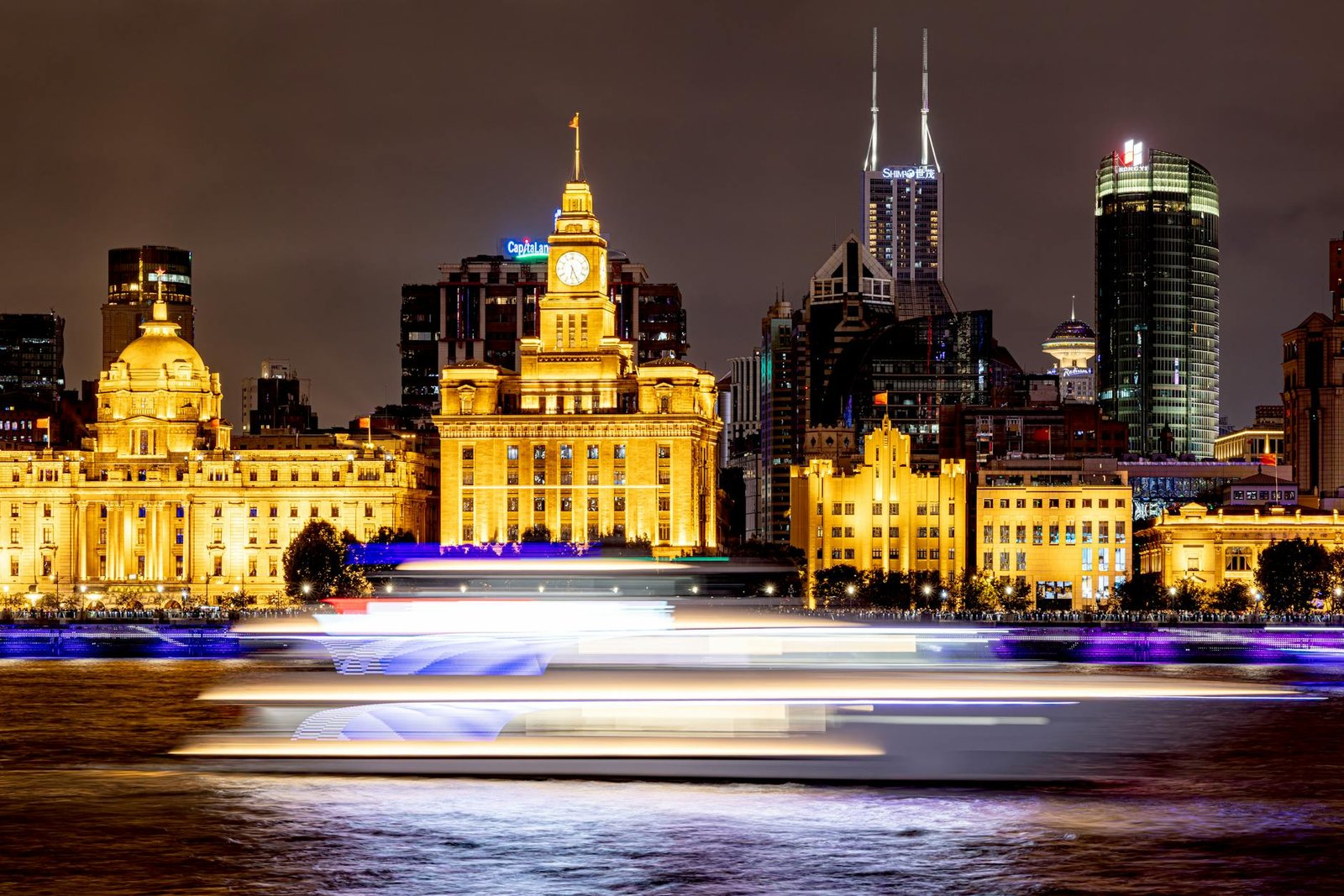
Few arrivals in the world match the spectacle of sailing into Shanghai — a city that somehow feels ancient and breathlessly futuristic all at once. From the deck of your ship, the Huangpu River unfolds like a film set, the legendary Bund’s colonial facades on one side and Pudong’s sci-fi skyline spiking the horizon on the other. You’ll know immediately that this city is going to demand everything you’ve got.
Arriving by Ship
Shanghai’s main cruise terminal is the Shanghai International Cruise Terminal, located in the Baoshan District at the mouth of the Huangpu River. Some larger vessels dock at the Wusongkou International Cruise Terminal, which opened in 2011 and is designed to handle the biggest ships afloat. Both terminals are well-organised with customs facilities, taxi ranks, and metro access nearby.
The sail-in along the Huangpu is genuinely one of the great maritime approaches anywhere in Asia. You pass working tugboats, container barges, and traditional wooden vessels, all dwarfed by the glittering towers of Lujiazui in the distance. Give yourself time on deck — this is not a morning to sleep in.
Things to Do

The sheer scale of Shanghai can feel overwhelming, so it helps to think in neighbourhoods. The Bund is the obvious starting point — a kilometre-long promenade of 1930s European architecture facing the river — but resist the urge to rush. Wander slowly, then cross to Pudong for a very different experience. The Shanghai Tower, at 632 metres, is China’s tallest building, and the observation deck on the 118th floor offers views that genuinely make your head swim. 🎟 Book: 4-Hour Private Tour of Pudong with China Art Palace Museum and Shanghai Tower
For something more intimate, head to the French Concession, where plane trees shade boutique-lined streets, jazz clubs hint at the city’s 1920s glamour, and life moves at a more human pace. History lovers shouldn’t miss the Yuyuan Garden in the Old City, a classical Ming-dynasty retreat hiding just minutes from the neon chaos of the bazaar surrounding it. If you want to experience Shanghai through local eyes, a guided walking tour is one of the smartest investments you can make on a port day. 🎟 Book: Shanghai City Guided Walking Tour | China's 1st and Best Rated
In the evening, the city transforms. The China Acrobatics Show is a long-standing Shanghai institution — performers push the boundaries of what a human body can apparently do, and it’s spectacular for all ages. 🎟 Book: China Acrobatics Show and Shanghai Evening Tour
Local Food
Shanghai cuisine is sweeter and richer than most of China’s regional styles, built around a technique called “red braising” that uses soy sauce, Shaoxing wine, and rock sugar to produce deeply savoury, lacquered meats. The city’s signature dish is xiaolongbao — those delicate soup dumplings that you must eat carefully unless you enjoy scalding your chin in public. Din Tai Fung has branches here, but for the real experience, seek out a neighbourhood spot in the Old City where they’re hand-folded in front of you.
Don’t leave without trying shengjianbao (pan-fried pork buns with a crackling golden base), hong shao rou (red-braised pork belly), and a bowl of wonton soup from a street-side stall. For something sweet, tangyuan — glutinous rice balls in warm ginger broth — are perfect on a cool morning. A visit to the Yuyuan Bazaar puts you right at the heart of Shanghai’s street food culture, noisy and delicious in equal measure.
Shopping

Shanghai is one of Asia’s great shopping cities, and the range is extraordinary. Nanjing Road, stretching nearly six kilometres, is the headline act — a pedestrianised boulevard of department stores, international brands, and souvenir shops that never seems to close. For higher-end retail, the xintiandi district blends heritage shikumen (stone-gate house) architecture with designer boutiques and concept stores.
If you’re after something more unique, the antiques market at Dongtai Road is a treasure hunt of Mao-era memorabilia, jade jewellery, calligraphy scrolls, and vintage porcelain. Speaking of which, if you want to bring home a genuinely meaningful skill, a session learning Chinese calligraphy with a working artist is one of those rare travel experiences that stays with you long after the ink dries. 🎟 Book: 2-Hour Chinese Calligraphy with an Artist in Shanghai, China
Practical Tips
- Visa requirements: Most nationalities need a Chinese visa in advance, though Shanghai does offer a 144-hour transit visa exemption for eligible passport holders — check carefully before you travel.
- Currency: The Chinese yuan (CNY/RMB) is the local currency. ATMs are widely available, and WeChat Pay is used almost universally, so it’s worth setting up if you plan to spend time ashore.
- Getting around: The metro is excellent, clean, and cheap. Taxis are plentiful but carry your hotel address written in Chinese characters.
- Language: English is limited outside tourist areas — download a translation app before you leave the ship.
- Weather: Summers are hot and humid; spring and autumn are the most comfortable times to explore on foot.
Cruises That Visit Shanghai China
Shanghai is one of Asia’s most important cruise homeports, with major lines treating it as both a turnaround city and a marquee port of call. Royal Caribbean, Celebrity Cruises, and Costa Cruises all operate regular sailings from Shanghai, typically running 3 to 7 nights to destinations including Japan, South Korea, and Vietnam. Princess Cruises also features Shanghai prominently in its Asia programmes, often pairing it with ports like Beijing (Tianjin), Osaka, and Busan on 10 to 14-night itineraries.
MSC Cruises and Norwegian Cruise Line have expanded their Asia presence significantly, with Shanghai frequently appearing as either a homeport or a key stop on longer trans-Asia voyages of 14 nights or more. For travellers combining a cruise with broader Chinese sightseeing, small-group land tours that link Shanghai with Beijing and Xi’an make an excellent pre- or post-cruise option. 🎟 Book: 8-Day Small-Group China Tour to Beijing, Xi'an and Shanghai
The best time to cruise from Shanghai is generally September through November, when temperatures are mild, skies are clearer, and typhoon season is winding down. Spring (April–May) is also excellent. Summer sailings are popular but come with high humidity and the occasional tropical storm risk.
🚢 Cruises That Stop at Shanghai China
Ready to book a cruise to Shanghai China?
Compare itineraries, prices, and cabin types from all the major cruise lines — with a best price guarantee and no booking fees.
🔍 Search Cruises to Shanghai China →
Affiliate link — we may earn a commission if you book, at no extra cost to you.
Shanghai rewards the curious and the unhurried in equal measure, but even a single port day leaves a mark. Whether you’re gazing down from the Shanghai Tower, wrestling with soup dumplings in a laneway canteen, or simply standing on the Bund at dusk watching the river traffic glide by, you’ll leave with the unmistakable feeling that this city is writing its own rules — and doing it magnificently.
🎟️ Things to Book in Advance
These highly-rated experiences fill up fast — book before you arrive to avoid missing out.


This page contains affiliate links. If you book through them, we may earn a small commission at no extra cost to you.
📍 Getting to Shanghai China
Use the interactive map below to explore the port area and plan your route from the terminal.
Leave a Reply