

European River Cruises
European River Cruises
Bernkastel-Kues Cruise Port Guide: Things to Do & Practical Tips
Germany
Ships typically anchor in the Moselle River and tender passengers to the town center pier, or occasionally dock at the small river port depending on water levels and ship size.
Choose the Right Port Day
Best Overall
Combine the Marktplatz stroll, a wine tasting at one of the small cellar producers, and the castle climb — that's the Bernkastel-Kues experience in one efficient loop.
Best Beach
Not relevant — this is an inland river valley port with no beach options.
With Kids
The steep castle ruin hike is genuinely fun for older kids; younger children do well exploring the cobbled lanes and grabbing pastries from bakeries on Burgstraße.
Only 3-4 Hours
Walk directly to Marktplatz, admire the half-timbered Spitzhäuschen, grab a glass of Riesling or Mosel Sekt at a riverside wine bar, then climb the short trail up to Landshut Castle ruins for the valley view before heading back.
Cheapest Option
Walk the old town, cross the pedestrian bridge to Kues, and spend the afternoon at wine bars where a glass of local Riesling runs roughly €3–6. Costs almost nothing.
What To Avoid
Skip the overpriced packaged wine gift sets sold near the dock — better bottles at lower prices are found in local wine shops further into town. Don't spend your whole port day on the ship-organized wine tour if you're comfortable walking independently; you can do the same thing for a fraction of the price.
Top Things To Do
1
Marktplatz & the Spitzhäuschen
The market square is the visual centrepiece of the town — medieval half-timbered buildings, a stone fountain, and the famously crooked Spitzhäuschen house that appears to lean over the alley. Spend time here before the day-tripper crowds arrive mid-morning.
2
Landshut Castle Ruins
A 20–30 minute uphill walk from the market square brings you to the ruined 14th-century castle above the town. The panoramic view over the Moselle valley and vine-terraced slopes is the best in the area. Go early to beat the heat and the groups.
3
Moselle Wine Tasting at a Local Cellar
Several small wine producers along Burgstraße and in Kues open their cellars to visitors. Riesling is king here — dry, off-dry, and Spätlese styles are all worth trying. Weingut Witwe Dr. H. Thanisch and similar family estates offer informal tastings.
4
St. Michael's Fountain & Burgstraße Stroll
The street running from Marktplatz toward the castle trail is lined with independent wine shops, small restaurants, and handcraft stores. The 17th-century St. Michael's Fountain anchors the square. Good for window shopping and photography without any admission cost.
5
Pedestrian Bridge Walk to Kues & the Cusanusstift
Cross the old pedestrian bridge to the Kues side and visit the Cusanusstift, a 15th-century charitable foundation and hospital built by theologian Nicholas of Cusa, with a small wine cooperative attached. Less touristy than Bernkastel and worth the 15-minute walk across.
Book with the ship, or on your own?
Booking independently
- Often noticeably cheaper than the ship’s version of the same tour.
- Smaller groups and local operators, with traveler reviews you can read before you pay.
- Free cancellation on most tours, usually up to 24 hours before.
When the ship’s excursion makes sense
- Short port calls or long transfers where the timing is tight.
- Tender-only stops where getting ashore can run late.
- The ship waits for its own delayed excursions — it won’t wait for independent ones, so leave a buffer before all-aboard.
We may earn a commission when you book through our links, at no extra cost to you — it’s how we keep these guides free.
Quick Take
- Port Type
- Historic Small River Port
- Best For
- Wine lovers, walkers who enjoy medieval old towns, slow-paced half-days with good food and scenery
- Avoid If
- You need high-energy activities, need wheelchair-friendly terrain throughout, or have already visited the Moselle wine villages multiple times
- Walkability
- Excellent — the old town is tiny and almost entirely on foot; the market square is under 10 minutes from any river dock
- Budget Fit
- Very good — wine by the glass, bakeries, and the old town itself are affordable; splurges are optional
- Good For Short Calls?
- Perfect half-day port; a full day is possible but you will run out of new things to see by early afternoon
Port Overview
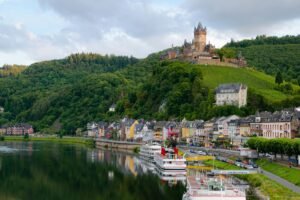
Bernkastel-Kues sits in a tight bend of the Moselle River in the Rhineland-Palatinate wine region, roughly midway between Trier and Koblenz. Most river cruise ships — Viking, AmaWaterways, Uniworld, Avalon, and the rest — moor directly along the Moselle embankment, putting you within a 5–10 minute walk of the old town market square. It is one of the most photogenic stops on any Moselle itinerary.
The town is genuinely small. Bernkastel occupies the eastern bank and Kues the western, connected by a pedestrian bridge. Together they hold maybe 7,000 residents. That compactness is both the appeal and the limitation — you can cover the highlights comfortably in three to four hours, and by early afternoon most independent walkers have seen what there is to see.
This port earns its place on every Moselle cruise because it delivers exactly what people come to the river for: medieval streetscapes, local wine, river views, and a castle ruin above the vines. It is not a launching point for major day trips — it is the destination itself. Go ashore, walk slowly, drink well.
Is It Safe?
Bernkastel-Kues is extremely safe by any standard. Petty crime is rare, the streets are quiet, and tourist infrastructure is straightforward. The only real risk is the steep, uneven paths leading up to Landshut Castle, which can be slippery after rain — wear sensible shoes. There is nothing here that requires particular caution.
Accessibility & Walkability
The flat riverfront and the broad pedestrian areas around Marktplatz are manageable for most mobility levels. However, the old town is heavily cobblestoned and the lanes are narrow, making wheelchairs and mobility scooters genuinely difficult. The castle climb is a proper hill trail and is not accessible. If mobility is limited, the riverside promenade and the lower market area still offer a pleasant hour ashore without the uphill sections.
Outside the Terminal
There is no enclosed terminal building — river cruise ships moor directly along the Moselle embankment using a gangplank. You step off the ship and you are essentially already in town. Within two minutes you can see the old town roofline. The embankment path leads straight toward the pedestrian zone and Marktplatz. In peak season (June–September) other ships may be moored alongside yours; you may need to cross a neighbouring vessel's deck to reach shore, which is standard practice on Moselle river cruises.
Local Food & Drink
Bernkastel-Kues has a solid concentration of wine taverns, riverside restaurants, and bakeries for a town its size. The local cuisine is Rhineland-Palatinate straightforward — Flammkuchen (thin-crust tart with crème fraîche and onion), hearty pork dishes, river fish when available, and excellent bread. Prices are reasonable by German tourist standards.
The best practical lunch option is one of the Weinstuben (wine taverns) just off Marktplatz — look for handwritten daily menus, a sure sign of a kitchen that actually cooks. Grab a glass of Mosel Riesling with your meal; the local wine is better and cheaper here than almost anywhere else in Germany. Avoid the most prominent waterfront terraces right next to where ships dock — these tend to be priced up for tourists. Walk two streets back for better value.
Shopping
Shopping here is small-scale and wine-dominated. The best purchases are bottles of local Riesling, Spätburgunder, or Sekt from independent wine shops — far better value than buying on the ship. Burgstraße has a handful of shops selling regional food products, ceramics, and the usual souvenir items. Don't expect department stores or boutiques. If wine is not your interest, shopping here is limited to a quick browse.
Money & Currency
- Currency
- Euro (EUR)
- USD Accepted?
- No
- Card Payments
- Good at restaurants and most wine shops; smaller market stalls and bakeries may be cash-preferred
- ATMs
- At least one ATM in the town centre; most cruise lines recommend having Euros before arriving at smaller Moselle ports
- Tipping
- Round up or leave 5-10% at sit-down restaurants; not obligatory but appreciated
- Notes
- This is a small German town — carry some cash. Card payments work at most established businesses but don't rely on it exclusively.
Weather & Best Time
- Best months
- May, June, September, October
- Avoid
- January and February — cold, grey, most wine cellars and restaurants keep reduced hours
- Temperature
- 15-25°C (59-77°F) during main cruise season of May–October
- Notes
- The Moselle valley can be warm and humid in July–August; spring and autumn offer ideal walking conditions and harvest season (September–October) is the most atmospheric time to visit.
Airport Information
- Airport
- Frankfurt Airport (FRA) is the main international gateway; Trier-Föhren Airport is nearby but serves very limited routes
- Distance
- Frankfurt is approximately 180 km (2-2.5 hours by car or train via Trier or Koblenz)
- Getting there
- Train via Koblenz or Trier connecting to Frankfurt; taxi or private transfer for pre/post cruise
- Notes
- Most river cruise passengers fly into Frankfurt and transfer to their embarkation point. Bernkastel-Kues is not a common embarkation port — check your itinerary, as most Moselle cruises begin in Trier or Cochem.
Getting Around from the Port
Walking
The primary and best way to explore. Marktplatz, the riverfront, Burgstraße, and the bridge to Kues are all flat or gently sloped. The castle trail has a moderate incline.
Taxi
A small number of taxis serve the town; useful if you want to reach outlying vineyards or the upper castle area without the hike.
Book a transfer 5% off with code TPO5 at checkoutBicycle rental
A few rental options exist in the area; the Moselle Cycle Path runs through town and is flat along the river.
Ship excursions
All major river cruise lines offer guided town walks and wine cellar visits. Convenient but not necessary given how walkable this port is.
Details last checked April 2026
Check The Port Traffic
Cruise Ships in Port
Once you have your shore plan, use the schedule to see how busy the harbour will be on your date, plus the ships, lines, and published call windows.
Sun
Mon
Tue
Wed
Thu
Fri
Sat
1
2
3
4
5
6
7
8
9
10
11
12
13
14
15
16
17
18
19
20
21
22
23
24
25
26
27
28
29
30
31
Quiet (1–2)
Busy (3–4)
Packed (5+)
0 scheduled calls
July 6, 2026
No scheduled cruise ship calls were found for this date selection. Pick a highlighted day on the calendar above, widen the range, or search for a different ship or line.
Planning a cruise here?
Viking River Cruises, Uniworld, AmaWaterways & more sail to Bernkastel-Kues.
Practical Tips for Cruise Passengers
- Get off the ship early — Marktplatz is most photogenic and least crowded before 10am when day-tripper coaches arrive.
- Wear comfortable shoes with grip; the cobblestones are beautiful but uneven, and the castle path can be slippery after rain.
- Buy wine directly from a producer cellar on Burgstraße rather than from souvenir shops near the dock — better selection, lower prices, and you can taste before you buy.
- The castle ruin hike takes about 25 minutes uphill from the market square; it's worth every step for the valley view, but skip it if the weather is wet or you have limited mobility.
- If your ship is double-moored (another ship moored alongside), factor in a few extra minutes to cross the neighbouring vessel's deck — it's normal on the Moselle but easy to forget when timing your return.
- Kues on the western bank is quieter and less visited than Bernkastel — cross the pedestrian bridge if you want to escape the ship crowd for an hour.
Frequently Asked Questions
No — this is one of the easiest river ports to explore independently. Everything worth seeing is within walking distance of the dock, and a glass of Riesling costs far less at a local wine bar than on a packaged tour.
About 25-35 minutes uphill from Marktplatz depending on your pace, plus time at the top and the descent. Budget 1.5 hours total for the round trip with views.
Yes for older kids who enjoy exploring medieval lanes and a manageable castle hike. Very young children in strollers will find the cobblestones challenging, but the flat riverfront and market area work fine.
The medieval architecture, castle ruins, and Moselle valley scenery are all worthwhile regardless of your interest in wine. The Cusanusstift in Kues adds a cultural and historical angle for those wanting more than a stroll.
You simply walk across the neighbouring ship's deck — crew from both vessels manage this routinely and it is safe and common on the Moselle. Allow an extra 5 minutes when returning to the ship before departure.
Find cruises to Bernkastel-Kues, Germany
Compare sailings and book with no fees — best price guaranteed.
We may earn a commission when you book through our links, at no extra cost to you — it’s how we keep these guides free.
✉ Sailing to Bernkastel-Kues? Get your port-day plan
Tell us your sail date and we’ll email you a short Bernkastel-Kues plan about 60 days out — when the good excursions start selling out — plus a final checklist 2 weeks before. Two emails, then done. Unsubscribe anytime.
Same itinerary network
View All
Ports Often Paired With Bernkastel-Kues
European River Cruises

European River Cruises
European River Cruises
